
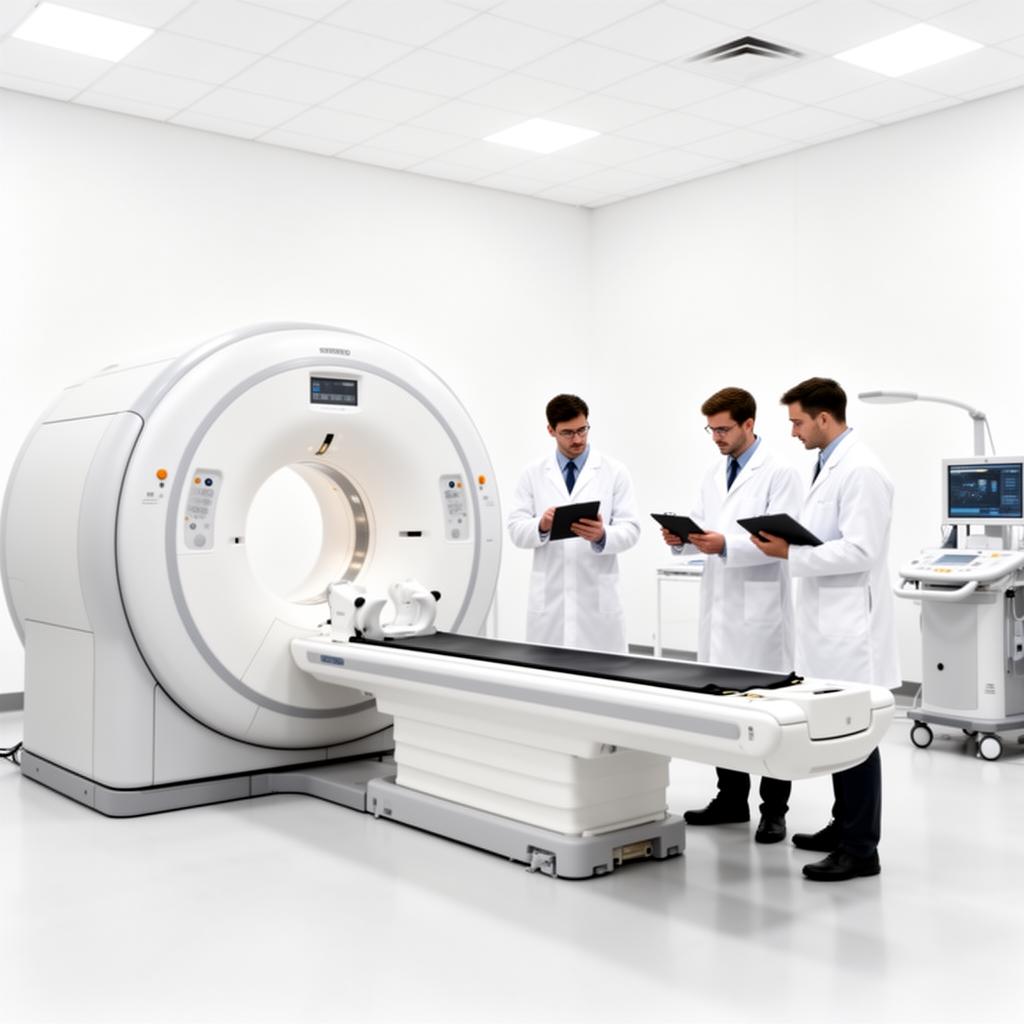
Refurbished medical equipment delivers 40–85% cost savings versus new systems while meeting the same clinical and regulatory standards. This 2026 buyer's guide covers prices, ISO 13485 and FDA refurbishment compliance, warranty norms, modality-by-modality buying tips for MRI, CT, cath lab and X-ray, and the total cost of ownership for hospitals in Africa, India, the Caribbean, and other emerging markets.
What Is Refurbished Medical Equipment? (And What It Is Not)
Refurbished medical equipment is pre-owned diagnostic or therapeutic equipment — including MRI scanners, CT scanners, cath labs, C-arms, ultrasound systems, and digital X-ray — that has been professionally inspected, repaired, tested, recalibrated, and certified to perform to original manufacturer (OEM) specifications. According to the U.S. Food and Drug Administration (FDA) and the International Medical Device Regulators Forum (IMDRF), refurbishment is a structured, quality-controlled process that restores a medical device to a safe and effective condition without significantly changing its original performance, safety specifications, or intended use.
Refurbished is fundamentally different from 'used' or 'as-is' equipment. A used MRI is sold in whatever condition it was decommissioned in, with no testing, no warranty, and no guarantee of functionality. A refurbished MRI has been disassembled to component level, worn parts (cold heads, gradient coils, RF amplifiers, detectors, X-ray tubes) replaced or rebuilt, software updated where licensable, mechanical and electrical safety verified per IEC 60601, and image quality re-validated against OEM acceptance criteria. The two categories should never be priced or evaluated the same way.
In 2026, the global refurbished medical equipment market is valued at over USD 14 billion and growing at roughly 10% CAGR, according to industry analyses by Grand View Research and MarketsandMarkets. Growth is being driven by hospital cost pressure in developed markets and by rapid diagnostic infrastructure expansion in emerging markets across Africa, India, Southeast Asia, the Middle East, and the Caribbean — all regions where Elesonic Group operates extensively.
Refurbished vs New Medical Equipment: 2026 Price Comparison
The most compelling reason hospitals choose refurbished medical equipment is cost — but the savings vary dramatically by modality. Here is a 2026 reference table for a fully installed, warrantied, qualified-refurbished system versus a new OEM equivalent.
MRI 1.5T (Siemens Aera, GE Optima 450w, Philips Ingenia): New $1.4M–$2.8M vs Refurbished $200K–$500K — savings of 65–85%. MRI 3.0T (Siemens Skyra, GE Discovery 750w, Philips Ingenia 3T): New $2.2M–$3.5M vs Refurbished $450K–$900K — savings of 60–75%. CT 16-slice (Siemens Emotion 16, GE BrightSpeed): New $300K–$600K vs Refurbished $80K–$180K — savings of 60–75%. CT 64–128-slice (Siemens Definition AS, GE Optima 660, Canon Aquilion): New $700K–$1.4M vs Refurbished $180K–$450K — savings of 55–70%.
Cath lab single-plane (Philips Allura, Siemens Artis Q, GE Innova): New $1.0M–$2.0M vs Refurbished $250K–$650K — savings of 55–75%. Cath lab biplane: New $2.0M–$3.5M vs Refurbished $500K–$1.1M — savings of 60–75%. C-arm mobile (OEC 9900, Ziehm Vision, Philips Veradius): New $120K–$250K vs Refurbished $25K–$80K — savings of 60–80%. Digital X-ray (DR rooms): New $80K–$180K vs Refurbished $25K–$70K — savings of 55–75%. Ultrasound premium cardiac/general (GE Vivid, Philips EPIQ): New $90K–$200K vs Refurbished $25K–$70K — savings of 60–75%.
Beyond the equipment itself, hospitals should expect installation, site preparation, freight, and training to add 8–18% to the system price for refurbished projects in developing markets. Even with these adders, the total landed cost of refurbished equipment remains 40–80% below new — the single largest controllable lever in any imaging capital plan.
Quality Standards: ISO 13485, IEC 60601 and FDA Refurbishment Guidance
Reputable refurbished medical equipment is built on three internationally recognized quality pillars. First, ISO 13485 — the global Quality Management System standard for medical devices — governs the supplier's processes for sourcing, inspection, repair, traceability, document control, and post-market surveillance. Any serious refurbisher in 2026 must hold a current ISO 13485 certificate audited by a recognized notified body. Elesonic Group maintains ISO 13485 certification across its refurbishment operations.
Second, IEC 60601-1 governs basic safety and essential performance for medical electrical equipment, with modality-specific 'collateral' standards: IEC 60601-2-33 for MRI, IEC 60601-2-44 for CT, IEC 60601-2-43 for interventional X-ray (cath labs and C-arms), and IEC 60601-2-54 for diagnostic X-ray. Every refurbished system should ship with a documented IEC 60601 electrical-safety test report and modality-specific image quality acceptance results.
Third, the FDA in the United States and equivalent regulators (CE in the EU, CDSCO in India, ANVISA in Brazil, NAFDAC in Nigeria, SAHPRA in South Africa) recognize refurbishment as a legitimate activity, distinct from 'remanufacturing.' The FDA's 2018 report 'Servicing of Medical Devices' explicitly affirms that quality refurbishment by a competent third party does not compromise safety or effectiveness when performed under a documented Quality Management System. Buyers should request the refurbisher's QMS certificate, a copy of the refurbishment work order, and an OEM-equivalent acceptance test protocol with every system.
The 12-Step Refurbishment Process — What Actually Happens
Understanding what 'refurbished' really means requires looking inside the process. A professional refurbishment of a 1.5T MRI or 64-slice CT typically involves 12 documented steps spread over 6–14 weeks: (1) Source qualification — equipment is acquired only from verified hospitals or asset-recovery channels, with original installation history, scan logs, and OEM service records. (2) Pre-deinstallation testing — performance baseline captured on-site before the system is touched. (3) Professional pickup and shipping with shock and tilt monitoring, climate-controlled transport for cryogenic systems.
(4) Bench-level disassembly in a controlled refurbishment facility. (5) Component-level inspection and testing — gradient coils, RF chain, X-ray tubes, detectors, cold heads, gantry bearings, high-voltage tanks, image processors. (6) Replacement of all consumable and life-limited parts using OEM or OEM-equivalent components with full traceability. (7) Mechanical refurbishment — bearings, drive systems, patient table, covers. (8) Electrical safety testing per IEC 60601-1.
(9) Software re-installation and update to the highest licensable version. (10) Cosmetic refurbishment — repainting, cover replacement, decal renewal so the system arrives looking new. (11) Image quality validation against OEM acceptance test protocols (ACR phantom for MRI/CT, AAPM test patterns for X-ray). (12) Final QA documentation package — refurbishment work order, parts list, test results, IEC safety report, and warranty certificate. Hospitals should refuse delivery of any refurbished medical equipment that does not arrive with this complete documentation package.
Buying Refurbished MRI Machines (1.5T and 3.0T) in 2026
Refurbished MRI is the highest-value category in the refurbished medical equipment market. The most popular 1.5T platforms in 2026 are the Siemens Magnetom Aera, GE Optima MR450w, and Philips Ingenia 1.5T — all designed with wide bores (70 cm), short magnets, and modern RF coil architectures. Refurbished pricing for these systems ranges from $250,000 to $500,000 fully installed, compared to $1.6M–$2.4M new.
When buying a refurbished MRI, focus on three things: magnet condition, coil suite, and software level. The magnet's helium boil-off rate, ramp history, and field homogeneity determine remaining service life — request the magnet log. The coil suite (head, neck, spine, body, knee, breast, cardiac) determines clinical capability — a stripped-down coil package can cripple a great magnet. Software level (e.g., Siemens syngo MR D13/E11, GE 25.x/27.x, Philips R5.x) governs sequence availability, advanced applications (DTI, perfusion, MRCP), and ongoing OEM support.
For 3.0T refurbished MRI — popular models include the Siemens Skyra, GE Discovery MR750w, and Philips Ingenia 3T — pricing runs $450K–$900K versus $2.2M–$3.5M new. 3.0T is the right choice for high-volume neuro, MSK, and research-oriented programs. Hospitals in India, the Gulf, and tier-1 African capitals are increasingly choosing refurbished 3.0T to compete clinically with academic centers at a fraction of the cost.
Buying Refurbished CT Scanners (16, 64, 128, 256-Slice)
Refurbished CT is the second-largest category. In 2026, the workhorse models on the refurbished market are the Siemens Somatom Definition AS (64/128-slice), GE Optima CT660 and Revolution EVO (64–128-slice), Philips Brilliance 64 and iCT (64–256-slice), and Canon Aquilion CXL/Prime (64–160-slice). Refurbished pricing: 16-slice $80K–$180K, 64-slice $180K–$320K, 128-slice $260K–$420K, 256-slice (high-end refurbished) $400K–$650K — versus $700K–$2M+ new for equivalent slice counts.
Critical due-diligence for refurbished CT: X-ray tube condition (remaining mAs life is the single biggest hidden cost — replacement tubes run $80K–$180K), detector status (broken modules degrade image quality and are expensive to replace), and gantry rotation hardware. Ask for the tube counter reading and a recent CTDI/dose-efficiency report. A refurbished CT with a low-hour replacement tube and current detector array can deliver 8–12 years of additional clinical service.
For developing-market hospitals, refurbished 16- and 64-slice CT is the sweet spot — they handle 95% of clinical indications (head trauma, abdomen-pelvis, chest, oncology staging, basic CTA) at one-fifth of the cost of a new premium system. Elesonic deploys refurbished CT scanners across Nigeria, Ghana, Kenya, Uganda, India, and the Caribbean, often paired with annual service contracts that further reduce total cost of ownership.
Refurbished Cath Labs, C-Arms and X-Ray: The Quick Reference
Refurbished cath labs are how mid-sized hospitals enter interventional cardiology profitably. The most refurbished platforms in 2026 are the Philips Allura Xper FD10/FD20, Siemens Artis Zee/Q, and GE Innova 2100/3100. Single-plane refurbished cath labs run $250K–$650K versus $1M–$2M new; biplane systems run $500K–$1.1M versus $2M–$3.5M new. Key checks: flat-panel detector condition (no dead pixels, current calibration), tube life remaining, and software level (especially for advanced QCA and 3D-RA features). A refurbished single-plane lab can support 600–1,200 PCI procedures per year — a strong financial proposition for any cardiac program.
Refurbished mobile C-arms — typically GE OEC 9900 Elite, Ziehm Vision RFD, Philips Veradius — are the most popular refurbished surgical imaging product worldwide. At $25K–$80K versus $120K–$250K new, they are accessible for orthopaedics, vascular surgery, urology, and pain management programs in any size hospital. The OEC 9900 in particular has a vast global parts ecosystem, making it the safest refurbished C-arm choice for developing markets.
Refurbished digital X-ray (DR) rooms and ceiling-suspended systems from Siemens (Ysio), GE (Discovery XR656), Philips (DigitalDiagnost), and Carestream are reliable, easy to deploy, and start at $25K–$70K. Combined with cloud or on-premise PACS, refurbished DR is the fastest, lowest-cost path to film-free radiology — a critical step for any hospital modernizing its diagnostic imaging department.
Total Cost of Ownership: Looking Beyond the Sticker Price
Total cost of ownership (TCO) for refurbished medical equipment is calculated as: acquisition price + installation + site preparation + annual service + parts + utilities + downtime cost, summed across the expected service life (8–15 years). For a refurbished 1.5T MRI at $350K with a $90K/year service contract, 10-year TCO is approximately $1.25M — versus $3.0M for a new 1.5T MRI on a $180K/year OEM contract over the same 10 years. The refurbished route delivers $1.75M in lifetime savings while providing the same clinical capability for 80–95% of routine MRI indications.
Service strategy is the single biggest TCO lever after acquisition. OEM service contracts on refurbished equipment are usually neither available nor cost-effective. Multi-vendor independent service organizations (ISOs) like Elesonic Group typically deliver service at 30–45% below OEM pricing, with response SLAs of 24–72 hours in their served regions. A multi-year service contract bundled with the refurbished system purchase is the strongest negotiating position a hospital can take.
Hidden costs to budget for: site preparation and rigging ($15K–$60K depending on modality and country), helium fills for MRI ($15K–$30K every 3–7 years), tube replacements for CT and cath lab ($80K–$180K mid-life), software licensing renewals ($8K–$25K/year), and import duties and clearance (varies — 0% to 22% depending on country). Elesonic provides itemized TCO models for every refurbished medical equipment quotation so hospitals can plan capital and operating budgets with full visibility.
Refurbished Medical Equipment for Africa, India and the Caribbean
For hospitals in developing markets, refurbished medical equipment is not just a cost-saving measure — it is often the only commercially viable path to advanced diagnostic imaging. The World Health Organization (WHO) estimates that two-thirds of the world's population lacks access to basic diagnostic imaging, and that closing this gap with new OEM equipment alone would require trillions in capital investment. Refurbished equipment, sourced and supported responsibly, is central to closing the global imaging gap.
Country-specific considerations matter. In India, customs duty on medical imaging equipment is generally low for refurbished systems with proper Form CDSCO registration; Elesonic handles registration and clearance directly. In Nigeria, NAFDAC import permits and pre-shipment inspection are mandatory — all factored into Elesonic's turnkey delivery. In Kenya and Uganda, the Pharmacy and Poisons Board / NDA require refurbisher QMS evidence. In Jamaica, Trinidad & Tobago and Barbados, equipment must comply with regional CARICOM medical device guidelines.
Power quality is a separate technical concern. MRI, CT, and cath lab systems require stable mains supply with tightly controlled voltage, frequency, and harmonic distortion. Refurbished medical equipment installed in markets with unstable grids must be paired with appropriately sized UPS and voltage stabilizers — typically a $20K–$80K investment that protects a $300K+ refurbished asset. Elesonic includes site-survey and power-quality engineering as a standard part of every refurbished medical equipment project in Africa, the Caribbean, and parts of South Asia. See our knowledge base guide on power quality for medical imaging equipment for technical specifications.
How to Choose a Refurbished Medical Equipment Supplier in 2026
Twelve red-flag-free criteria to use when evaluating any refurbished medical equipment supplier: (1) Current ISO 13485 certificate from a recognized notified body. (2) Documented refurbishment process with sample work orders. (3) Transparent equipment provenance — original installation country, hospital type, scan log, age, and reason for decommission. (4) IEC 60601 electrical safety test report with each system. (5) OEM-equivalent image quality acceptance test (ACR phantom for MRI/CT). (6) Minimum 12-month parts-and-labor warranty (24 months for premium systems).
(7) In-region service capability — engineers, parts depot, and SLA in your country. (8) Multi-vendor capability — one supplier servicing MRI, CT, cath lab, X-ray reduces vendor friction. (9) Training included — applications training for radiographers, technical orientation for biomeds. (10) Itemized total cost of ownership model with the quotation. (11) Reference site visits available — talk to other hospitals running their refurbished medical equipment. (12) Honest disclosure of what was replaced, what was retained, and what is end-of-life within the warranty period.
Elesonic Group is built around all twelve criteria. With over two decades of experience, ISO 13485 quality systems, in-region service teams across India, Nigeria, Ghana, Uganda, Kenya, Jamaica, Trinidad & Tobago, and the wider West African and Caribbean regions, and a multi-vendor portfolio covering Siemens, GE HealthCare, Philips, Canon (Toshiba), and Hitachi, Elesonic is the partner of choice for hospitals buying refurbished medical equipment for sustainable, long-term clinical use.