
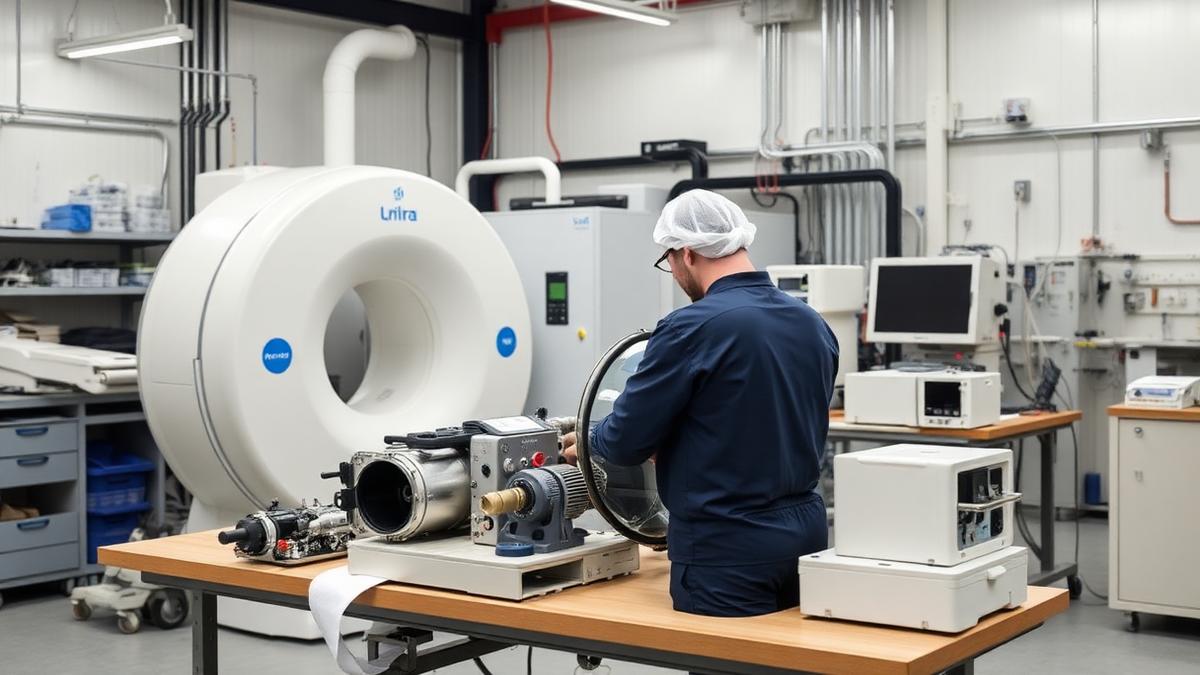
Engineers refurbishing medical imaging equipment in a quality-controlled facility
    ← Back to Blog|Equipment Guide

    How Refurbished Medical Imaging Equipment Works

    March 14, 202613 min read

    What actually happens during the refurbishment of an MRI, CT, or cath lab system? This guide takes you inside the process — from sourcing and inspection through component replacement, testing, and certification — explaining how quality refurbished equipment delivers reliable clinical performance.

    The Refurbishment Process: Step by Step

    Medical imaging equipment refurbishment is a systematic, quality-controlled process that transforms a decommissioned system into a fully functional, clinically reliable unit. The process typically spans 4–12 weeks depending on the modality and scope of work required. The International Electrotechnical Commission (IEC) provides framework standards for refurbishment quality.

    Step 1: Sourcing and Acquisition — Equipment is sourced from hospitals upgrading to newer technology, decommissioned clinical sites, or manufacturer trade-in programs. Elesonic evaluates system history (installation date, usage volume, maintenance records) before acquisition. Systems with excessive wear, major component failures, or incomplete history are rejected.

    Step 2: Receiving Inspection — Upon arrival at the refurbishment facility, a comprehensive baseline assessment is performed: visual inspection for physical damage, electrical safety testing, component-by-component functional evaluation, and documentation of all findings. This assessment determines the refurbishment scope and identifies components requiring replacement.

    Component-Level Refurbishment

    Step 3: Disassembly and Component Evaluation — The system is systematically disassembled, with each component individually tested against manufacturer specifications. For MRI: magnet homogeneity testing, gradient system evaluation, RF coil performance measurement, and cryogenic system assessment. For CT: detector calibration verification, gantry bearing and slip ring inspection, tube evaluation, and power system testing.

    Step 4: Component Replacement and Repair — All components that don't meet specifications are replaced or repaired. This includes: worn mechanical parts (cables, bearings, motors, brakes), degraded electronic components (power supplies, amplifiers, circuit boards), cosmetic elements (panels, covers, paint), and consumable items (tubes, filters, batteries). Critical components like MRI cold heads, CT detectors, and cath lab flat-panel detectors receive specialized attention.

    Step 5: Software Update — The system is updated to the latest available software version for its model generation. This may include: application software, system firmware, calibration routines, and security patches. Software availability depends on the manufacturer and generation — some newer features may not be backportable to older hardware platforms.

    Quality Assurance and Testing

    Step 6: Reassembly and System Integration — Components are reassembled following manufacturer documentation and quality procedures. All connections are verified, cable routing is restored to specification, and the system is powered up for integrated testing. This phase requires specialized engineering knowledge specific to each modality and manufacturer.

    Step 7: Performance Testing — Comprehensive testing verifies the system meets original manufacturer specifications: image quality testing (resolution, contrast, uniformity, artifacts), radiation output verification (for X-ray based systems), safety testing (electrical isolation, emergency stops, interlocks), mechanical testing (positioning accuracy, movement smoothness, locking mechanisms), and environmental testing (cooling system performance, noise levels).

    Step 8: Clinical Validation — The final step simulates actual clinical use: phantom scanning to verify diagnostic image quality, protocol testing to ensure all clinical applications function correctly, DICOM connectivity verification, and workstation functionality testing. Only systems that pass all tests receive certification for clinical deployment.

    Certifications and Quality Standards

    Quality refurbished equipment should carry specific certifications: CE Marking — indicates conformity with European health, safety, and environmental requirements. Essential for equipment deployed in most international markets. ISO 13485 — the international standard for medical device quality management systems. Ensures the refurbishment process follows documented, repeatable procedures with full traceability.

    The FDA's Center for Devices and Radiological Health (CDRH) distinguishes between 'refurbished,' 'reconditioned,' and 'used' equipment — each term has specific legal meaning regarding the level of restoration performed. CE-certified refurbishment from providers like Elesonic meets the highest standard: comprehensive restoration to original manufacturer specifications with documented quality management.

    Elesonic maintains both CE certification and ISO 13485 quality management system for all refurbished imaging equipment. Every unit ships with complete refurbishment documentation: component replacement records, test results, calibration certificates, and quality certificates. This documentation is essential for regulatory compliance and provides confidence in the system's reliability.

    Common Misconceptions About Refurbished Equipment

    Misconception 1: 'Refurbished means lower quality' — False. Properly refurbished equipment meets original manufacturer specifications. The physics of imaging (MRI magnet field, CT detector response, X-ray output) are restored to factory standards through the refurbishment process.

    Misconception 2: 'Refurbished equipment fails more often' — Not accurate for quality refurbished systems. Since worn components have been replaced and the entire system has been tested, a freshly refurbished system may actually be more reliable than an aging in-service unit that hasn't received comprehensive maintenance. The key variable is the quality of the refurbishment provider.

    Misconception 3: 'No warranty on refurbished' — Quality providers include comprehensive warranties. Elesonic provides 6–12 month warranties on all refurbished systems with optional extended coverage through service contracts. The warranty terms should be comparable to what OEMs offer on new equipment.

    Misconception 4: 'Can't get service for refurbished equipment' — Third-party service providers like Elesonic support refurbished equipment with the same multi-vendor expertise used for service contracts on any system. In fact, purchasing refurbished equipment with a service contract from the same provider (like Elesonic) creates a seamless lifecycle management relationship.

    Choosing a Refurbished Equipment Provider

    Not all refurbished equipment providers are equal. Essential criteria for evaluation: certifications — CE and ISO 13485 are non-negotiable. Refurbishment facility — the provider should have dedicated refurbishment facilities with appropriate infrastructure. Documentation — complete refurbishment records should be provided with every system. Warranty — minimum 6–12 months of comprehensive warranty.

    Service capability — the provider should offer ongoing service and maintenance for the equipment they sell. This ensures long-term support and creates accountability for the refurbishment quality. References — verified installations in your region demonstrating the provider's ability to deliver, install, and support equipment in your market.

    Elesonic Group meets all of these criteria as a vertically integrated imaging company: sourcing, refurbishment, sales, installation, and ongoing service — all under one roof with CE and ISO 13485 certification. This integrated model ensures quality accountability at every stage of the equipment lifecycle.

    Frequently Asked Questions

    What does 'refurbished' mean for medical imaging equipment?

    Refurbished medical imaging equipment has undergone a comprehensive restoration process: complete inspection, replacement of worn components, software updates, cosmetic restoration, performance testing, and clinical validation. CE-certified refurbishment from providers like Elesonic restores equipment to original manufacturer specifications with documented quality management.

    Is refurbished imaging equipment safe for patients?

    Yes. Properly refurbished equipment meets the same safety and performance standards as new equipment. The refurbishment process includes electrical safety testing, radiation output verification, image quality validation, and emergency system testing. CE and ISO 13485 certifications ensure compliance with international medical device safety standards.

    How long does the refurbishment process take?

    Equipment refurbishment typically takes 4–12 weeks depending on modality and scope. MRI systems generally take longest (8–12 weeks) due to magnet assessment and cryogenic system work. CT scanners take 6–8 weeks. X-ray and C-arm systems can be completed in 4–6 weeks.

    What components are replaced during refurbishment?

    All components not meeting specifications are replaced: worn mechanical parts (cables, bearings, motors), degraded electronics (power supplies, circuit boards), consumables (tubes, filters), and cosmetic elements (panels, paint). Critical components like MRI coils, CT detectors, and cath lab FPDs receive specialized attention.

    What certifications should refurbished equipment have?

    Essential: CE marking (European conformity), ISO 13485 (quality management system). Additional quality indicators: complete refurbishment documentation, component replacement records, test results, calibration certificates. The FDA distinguishes between 'refurbished' (highest standard), 'reconditioned,' and 'used' equipment.

    Does refurbished imaging equipment come with a warranty?

    Quality refurbished equipment includes 6–12 month comprehensive warranty covering parts and labor. Elesonic provides warranties on all refurbished systems with options for extended coverage through ongoing service contracts. Avoid providers that sell 'as-is' without warranty — this is a quality red flag.

    How does refurbished MRI refurbishment work specifically?

    MRI refurbishment includes: magnet homogeneity testing and shimming, cryogenic system assessment (helium levels, cold head condition), gradient system testing and component replacement, RF coil performance testing and replacement, software update, full calibration, and clinical image quality validation against OEM specifications.

    What is the difference between refurbished and used equipment?

    'Used' equipment is simply previously owned — no guarantee of condition or testing. 'Refurbished' equipment has undergone comprehensive inspection, component replacement, testing, and certification to restore it to manufacturer specifications. Always buy 'refurbished' from CE-certified providers, never simply 'used' without refurbishment documentation.

    Can refurbished equipment be serviced long-term?

    Yes. Multi-vendor service providers like Elesonic support refurbished equipment with the same expertise used for any imaging system. Purchasing refurbished equipment and a service contract from the same provider (Elesonic) creates seamless lifecycle management with guaranteed long-term support.

    How much cheaper is refurbished vs new imaging equipment?

    Refurbished savings by modality: MRI — 50–85% less than new ($200K–$500K vs $1.5M–$3M). CT — 50–70% less ($80K–$400K vs $200K–$2M). Cath Lab — 50–75% less ($250K–$800K vs $1M–$4M). X-ray — 50–70% less ($20K–$60K vs $60K–$150K). C-arm — 50–70% less ($30K–$150K vs $80K–$350K).

    Where does Elesonic source equipment for refurbishment?

    Elesonic sources equipment from: hospitals upgrading to newer technology in developed markets (US, Europe, Japan), manufacturer trade-in programs, decommissioned clinical sites, and healthcare system equipment rotations. All sourced equipment is evaluated for history, condition, and refurbishment potential before acquisition.

    Can refurbished equipment be installed in Africa?

    Yes. Elesonic specializes in refurbished equipment installation across Africa including: customs clearance assistance, specialized transport and rigging, site preparation guidance, professional installation, calibration, commissioning, and clinical training. Active installations in Nigeria, Kenya, Uganda, Ghana, Tanzania, and expanding across the continent.

    What imaging quality tests are performed on refurbished equipment?

    Image quality testing includes: spatial resolution measurement, contrast resolution verification, image uniformity checks, artifact evaluation, signal-to-noise ratio testing, and dose verification (for X-ray based systems). All results are compared against manufacturer specifications. Clinical phantom scanning validates diagnostic quality for actual clinical protocols.

    How does Elesonic ensure refurbishment quality?

    Elesonic maintains: CE certification for medical device quality, ISO 13485 quality management system with documented procedures, dedicated refurbishment facility with specialized tooling, component-level testing and traceability, comprehensive final testing against OEM specifications, and complete documentation package with every system.

    What is the environmental benefit of refurbished equipment?

    Refurbishing imaging equipment extends its useful life by 8–15+ years, diverting thousands of kilograms of electronics, metals, and specialized materials from landfills. MRI systems alone weigh 5–15 tons. The refurbishment model represents a circular economy approach to medical technology — maximizing value while minimizing waste.

    Can refurbished equipment software be updated?

    Software updates to the latest available version for the system's hardware generation are included in refurbishment. However, some newest features (available only on latest-generation hardware) cannot be backported. The system will have the most current software that its hardware platform supports.

    What logistics are involved in refurbished equipment delivery?

    International delivery includes: specialized crating and packaging, climate-controlled shipping (for MRI cryogenic systems), customs documentation and clearance, local transport and rigging to installation site, and unpacking and positioning. Elesonic manages all logistics including customs assistance and on-site delivery for African and Caribbean installations.

    How do I verify a refurbished system's quality before purchase?

    Verification steps: (1) Review refurbishment documentation, (2) Request test results and calibration certificates, (3) Verify CE and ISO 13485 certifications, (4) Check references from installations in your region, (5) Request a pre-delivery inspection (if practical), (6) Ensure warranty terms are documented in the purchase agreement. Elesonic provides all documentation and welcomes verification.

    What is the typical refurbished equipment lifespan?

    Refurbished equipment lifespan: MRI — 8–15+ additional years. CT — 7–12 years. Cath Lab — 7–12 years. X-ray — 10–20 years. C-arm — 8–15 years. Lifespan depends on: quality of refurbishment, ongoing maintenance, environment (power stability, climate), and usage volume. Regular service from Elesonic maximizes lifespan.

    What happens if refurbished equipment has problems?

    Quality refurbished equipment includes warranty coverage (6–12 months from Elesonic). During warranty: defects are repaired at no cost, including parts and labor. After warranty: ongoing service contracts provide continued coverage. The advantage of purchasing from an integrated provider like Elesonic: the same company that refurbished the equipment provides service — ensuring deep knowledge of each system's condition.

    Ready to Reduce Your Service Costs?

    Get a customized service proposal for your imaging equipment — MRI, CT, cath lab, X-ray, or C-arm.