
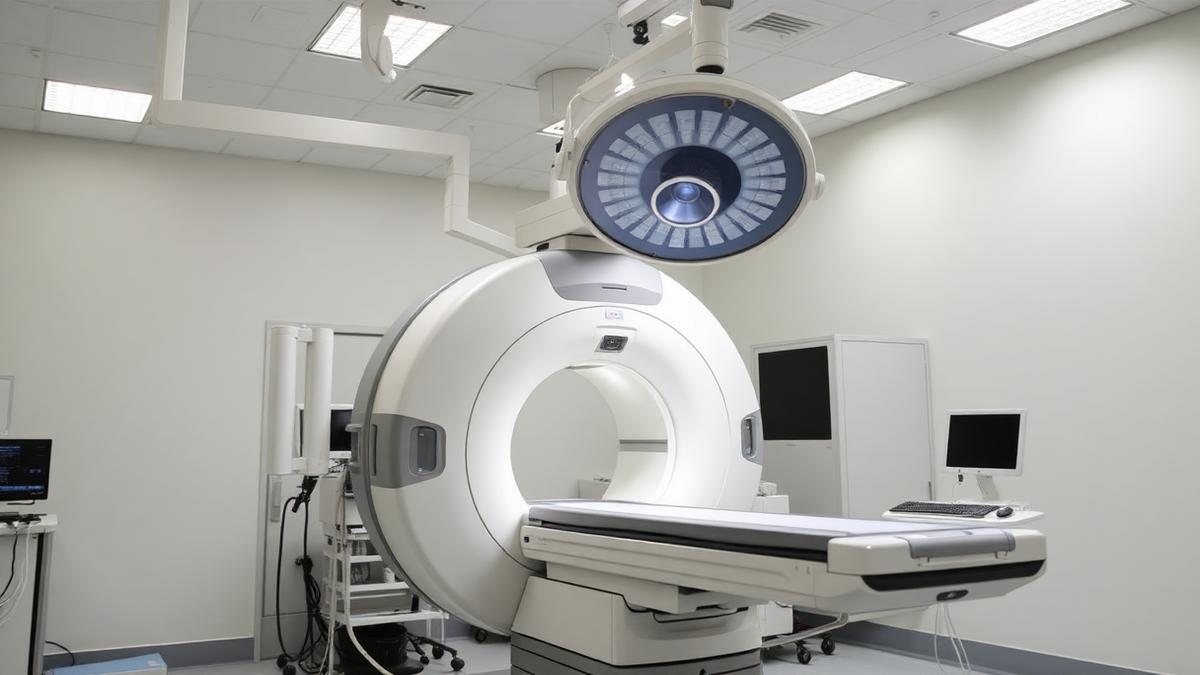
C-arm machines are essential surgical and diagnostic tools used across orthopedics, cardiology, pain management, and vascular surgery. This guide explains C-arm technology, compares mini vs full-size systems, analyzes costs, and provides selection criteria for hospitals.
What Is a C-Arm Machine?
A C-arm is a mobile fluoroscopy system named for its C-shaped arm that connects the X-ray source to the image detector. According to the American College of Radiology (ACR), C-arms provide real-time X-ray imaging during surgical and interventional procedures, enabling surgeons and physicians to visualize anatomy and guide instruments without open surgery.
C-arms are among the most versatile and widely used imaging systems in hospitals, used in operating rooms, emergency departments, pain management clinics, orthopedic practices, and cardiac catheterization. Their mobility makes them invaluable — unlike fixed room systems, C-arms can be moved between rooms and departments as needed.
Modern C-arm technology has evolved dramatically: from analog image intensifiers to digital flat-panel detectors, from standard-definition to high-resolution imaging, and from manual positioning to motorized, programmable movement. These advances improve diagnostic quality, reduce radiation dose, and enhance surgical workflow.
C-Arm Clinical Applications
Orthopedic Surgery — C-arms are indispensable in orthopedics for: fracture reduction and fixation (confirming alignment in real-time), joint replacement guidance (hip, knee, shoulder), spinal surgery (pedicle screw placement, fusion verification), and extremity surgery (hand, wrist, ankle procedures). Orthopedic use is the single largest C-arm application.
Pain Management — Fluoroscopy-guided procedures including: epidural steroid injections, facet joint blocks, nerve root blocks, sacroiliac joint injections, and radiofrequency ablation. Pain management requires good image quality at low dose — making modern C-arms with pulsed fluoroscopy ideal.
Vascular Surgery — Endovascular procedures including: angiography, angioplasty, stent placement, dialysis access creation, and EVAR (endovascular aneurysm repair). Vascular applications require large field-of-view detectors and advanced imaging features like DSA (digital subtraction angiography). Cardiac and Urology — C-arms support pacemaker implantation, ERCP procedures, retrograde pyelography, and urethral stent placement.
Mini C-Arm vs Full-Size C-Arm
Mini C-Arms — Compact, lightweight systems designed for extremity imaging (hands, wrists, feet, ankles, elbows). Cost: $20,000–$60,000 new, $10,000–$30,000 refurbished. Advantages: very low radiation dose, portable, no shielding requirements in many jurisdictions, and affordable. Limitations: small field of view (limited to extremities), lower power output (not suitable for large patients or deep anatomy).
Full-Size C-Arms — Standard mobile fluoroscopy systems for all clinical applications. Cost: $80,000–$350,000 new, $30,000–$150,000 refurbished. Available with image intensifier (lower cost) or flat-panel detector (higher image quality, lower dose). Powers: adequate for all patient sizes and all clinical applications. This is the workhorse C-arm for most hospitals.
Super C-Arms (Hybrid) — High-end systems with large flat-panel detectors, 3D imaging capability, and advanced features approaching fixed cath lab quality. Cost: $250,000–$600,000+. Used for complex vascular and interventional procedures in hybrid operating rooms.
C-Arm Cost Analysis
Equipment costs vary significantly by configuration: Mini C-arm — New $20,000–$60,000, Refurbished $10,000–$30,000. Full-size with Image Intensifier — New $80,000–$180,000, Refurbished $30,000–$80,000. Full-size with Flat-Panel Detector — New $150,000–$350,000, Refurbished $60,000–$150,000.
Annual service costs: Mini C-arm — $3,000–$8,000/year. Full-size with II — $8,000–$25,000/year. Full-size with FPD — $15,000–$40,000/year. Major cost items include: image intensifier reconditioning ($5,000–$15,000), X-ray tube replacement ($5,000–$20,000), and flat-panel detector repair ($15,000–$50,000).
Elesonic manufactures its own C-arm systems (Elemac CFD-9) and provides multi-vendor C-arm service, offering uniquely competitive pricing for both equipment and maintenance. As both manufacturer and service provider, Elesonic delivers OEM-level support at developing market pricing.
Selecting the Right C-Arm for Your Facility
Selection criteria by primary use case: If primarily orthopedic extremity work — consider a mini C-arm for cost savings and radiation reduction. If general surgical and orthopedic use — a full-size C-arm with image intensifier offers the best value. If vascular or interventional procedures — a full-size C-arm with flat-panel detector is recommended for image quality and dose management. If hybrid OR or advanced interventional — a super C-arm with 3D capability is justified.
Additional selection factors: mobility requirements (weight and form factor for moving between rooms), image quality needs (II vs FPD), radiation dose management features (pulsed fluoroscopy, last-image-hold, virtual collimation), monitor type and size, DICOM connectivity for PACS integration, and after-sale service availability.
For developing market hospitals, Elesonic recommends starting with a quality refurbished full-size C-arm with image intensifier ($30,000–$80,000) — this provides excellent imaging for orthopedics, pain management, and general surgery at the most accessible price point. Upgrade to FPD-equipped systems as clinical needs and budgets grow.
C-Arm Manufacturers Compared
Siemens (Cios Series) — Cios Alpha, Cios Spin, Cios Select, and Cios Fit. Known for excellent image quality, ergonomic design, and the hybrid-capable Cios Alpha. Popular refurbished: Cios Alpha, Cios Select. GE (OEC Series) — OEC One, OEC Elite, OEC 9900. Known for reliable build quality, strong image processing, and the compact OEC One design. Popular refurbished: OEC 9900, OEC Elite.
Philips (BV Series/Zenition) — BV Endura, BV Pulsera, and the latest Zenition platform. Known for dose management features and image quality. Ziehm (Vision Series) — German manufacturer known for excellent FPD-equipped C-arms. Vision RFD, Vision FD. Popular in European and developing markets. Elesonic (Elemac CFD-9) — Elesonic's own C-arm designed for developing markets — combining reliable performance with competitive pricing and manufacturer-direct service support.