
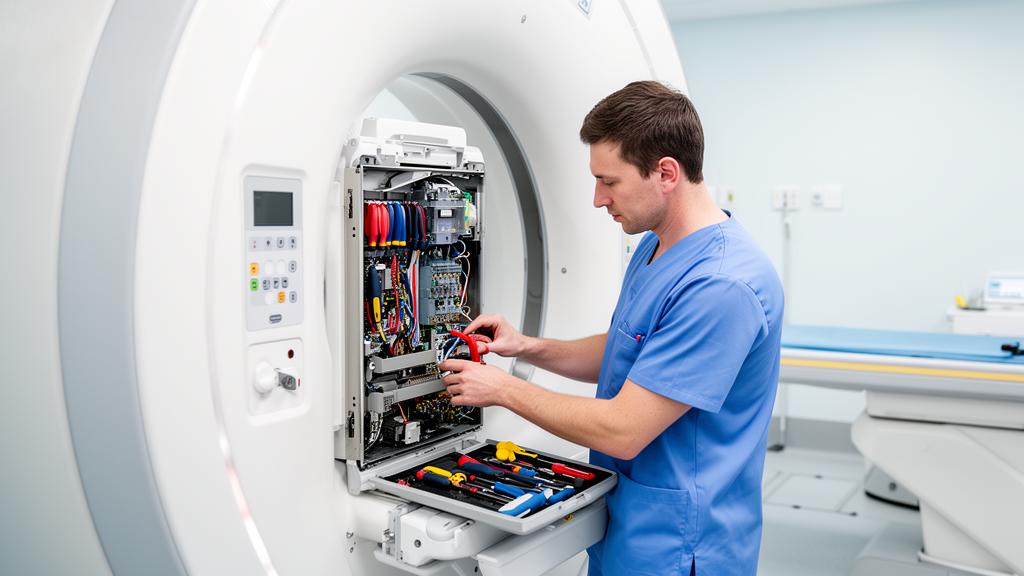
Should your hospital stick with OEM service or switch to a third-party provider? This comprehensive comparison covers cost, quality, response times, and risk factors to help you make the right decision.
The Great Service Debate: OEM or Third-Party?
Every hospital with medical imaging equipment faces this decision: continue paying premium prices for OEM service contracts, or switch to a qualified third-party provider that promises equivalent service at significantly lower cost. The answer isn't always straightforward.
This guide provides an objective comparison of OEM and third-party service models for MRI, CT, cath lab, and X-ray equipment — helping you make an informed decision based on your facility's specific needs, budget, and risk tolerance.
Cost Comparison: The Numbers Don't Lie
The most compelling reason hospitals consider third-party service is cost. Across all modalities, qualified third-party providers typically charge 30–40% less than OEM equivalents. For a mid-size hospital with an MRI, CT, and cath lab, this can mean annual savings of $150,000–$250,000.
Here's a typical comparison: MRI 1.5T — OEM: $180,000/year vs Third-party: $115,000/year. CT 64-slice — OEM: $130,000/year vs Third-party: $80,000/year. Cath Lab — OEM: $250,000/year vs Third-party: $160,000/year. Total: OEM $560,000 vs Third-party $355,000 — a savings of $205,000 per year.
These savings come from: lower labor costs (especially with India-based engineering), competitive parts pricing, refurbished component strategies, and lower overhead structures compared to large OEM organizations.
Quality and Safety: Are Third-Party Services Equivalent?
Quality is the primary concern hospitals have about third-party service. The answer depends entirely on the provider you choose. Leading third-party providers like Elesonic Group maintain CE certifications and ISO 13485 quality management systems — the same standards required of OEMs.
Key quality indicators to evaluate: engineering team credentials and training, parts sourcing and quality assurance procedures, response time commitments (SLA), uptime guarantees, and customer references in your region. A qualified third-party provider should be transparent about all of these.
It's worth noting that many third-party service engineers are former OEM engineers who bring years of manufacturer-specific training and experience to their new roles.
When OEM Service Makes More Sense
OEM service contracts still have advantages in certain scenarios: (1) brand-new systems under warranty — OEM service is often included or discounted during the warranty period, (2) software-dependent modalities where OEM locks software updates behind service contracts, (3) systems with unique proprietary technology that third-party providers haven't yet mastered, and (4) hospitals in regions with strong OEM service infrastructure but limited third-party options.
When Third-Party Service Is the Better Choice
Third-party service becomes the clear winner when: (1) your systems are 3+ years old and out of warranty, (2) you operate multi-vendor equipment (mixing Siemens, GE, Philips), (3) your budget is constrained — common in developing markets, (4) you value contract flexibility over rigid OEM terms, (5) you're in a region where OEM response times are slow, and (6) you need a partner who understands developing market economics.
For hospitals in Africa, India, and the Caribbean, third-party providers like Elesonic offer a particularly compelling value proposition: local support, competitive pricing designed for developing market budgets, and multi-vendor expertise that eliminates the need for multiple service contracts.
How to Transition from OEM to Third-Party Service
Transitioning from OEM to third-party service is straightforward: (1) Allow your current OEM contract to expire (don't break mid-term to avoid penalties). (2) Request proposals from qualified third-party providers. (3) Verify credentials — CE certification, ISO 13485, engineer training documentation, and regional references. (4) Conduct a system assessment — the new provider should inspect your equipment before proposing a contract. (5) Negotiate terms including response times, uptime guarantees, parts coverage, and pricing. (6) Plan the handover — coordinate the transition period to ensure no coverage gaps.