
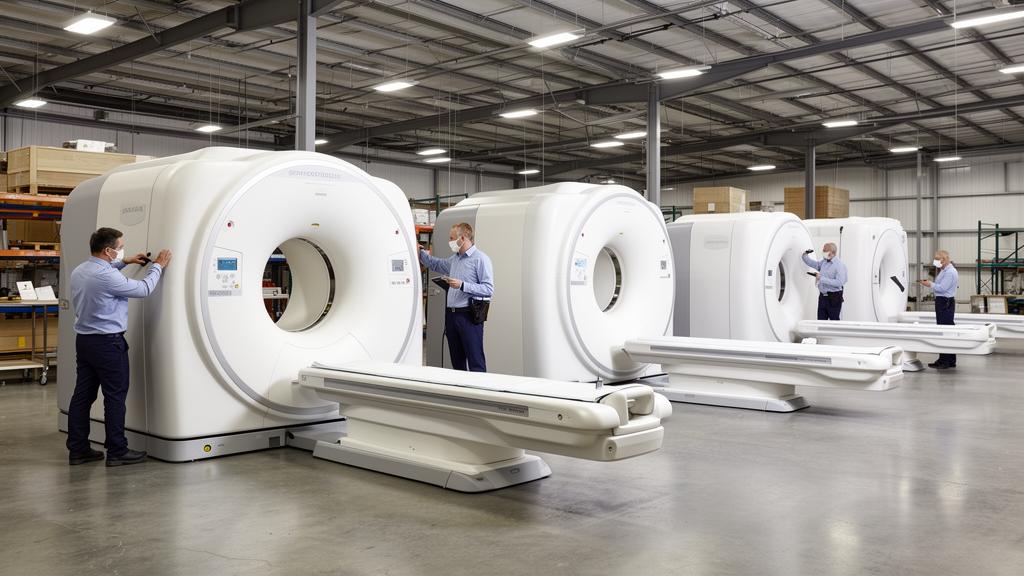
Africa's growing healthcare infrastructure faces a critical challenge: maintaining advanced imaging equipment. This article explores the service gap, its impact on patient care, and how providers like Elesonic are bridging it.
Africa's Medical Imaging Service Crisis
Africa has approximately 0.2 MRI machines and 0.4 CT scanners per million population — compared to 40+ MRI and 30+ CT scanners per million in developed nations. But even more concerning than equipment scarcity is the service crisis: an estimated 40–60% of medical imaging equipment in sub-Saharan Africa is non-functional at any given time, primarily due to inadequate maintenance.
This service gap has devastating consequences for patient care. When an MRI or CT scanner goes down in a country with limited alternatives, patients face delays, travel long distances, or simply go without critical diagnostic imaging.
Why Equipment Maintenance Fails in Africa
Several systemic factors contribute to the maintenance challenge: (1) OEM service costs that are designed for developed market economies — a $200,000/year MRI service contract is prohibitive for hospitals with total annual budgets of $1–$5 million. (2) Limited local engineering talent trained on advanced imaging modalities. (3) Parts logistics — shipping components from Europe or the US to Africa adds weeks of downtime and thousands in freight costs. (4) Power instability — voltage fluctuations and outages cause accelerated equipment degradation. (5) Climate challenges — heat and humidity stress cooling systems and electronic components.
The Third-Party Service Solution
Third-party service providers are emerging as the most viable solution to Africa's imaging maintenance crisis. By leveraging: (1) India-based engineering talent at 40–60% lower labor costs. (2) Strategic parts warehousing in key African locations. (3) Remote diagnostic technology for first-line troubleshooting. (4) Training programs for local biomedical engineers. (5) Service pricing designed for African market economics.
Elesonic Group exemplifies this approach. With headquarters in India and active operations across Nigeria, Kenya, Uganda, Tanzania, Rwanda, and the Caribbean, Elesonic provides multi-vendor imaging service at costs that African hospitals can actually sustain.
Building Local Capacity: The Long-Term Solution
Sustainable imaging maintenance in Africa requires building local engineering capacity. Progressive service providers invest in: training local biomedical engineers on advanced modalities, establishing spare parts depots in-country, creating preventive maintenance programs that local teams can execute, and providing remote supervision and support for complex repairs.
Elesonic's service model incorporates all of these elements, working with hospital biomedical teams to build local capacity while providing India-based engineering backup for complex issues. This hybrid model delivers reliable uptime while developing local expertise over time.
Country-Specific Service Landscape
Nigeria: West Africa's largest economy has the most advanced imaging infrastructure on the continent but faces severe maintenance challenges. Elesonic maintains active MRI, CT, and cath lab service operations in Lagos, Abuja, and other major cities.
Kenya & East Africa: Kenya serves as a regional hub for medical imaging in East Africa. Elesonic provides service support across Kenya, Uganda, Tanzania, Rwanda, and Burundi from this regional base.
Caribbean: Similar challenges to Africa — island geography adds logistics complexity. Elesonic's Caribbean service programs address the unique needs of island-based healthcare facilities.