
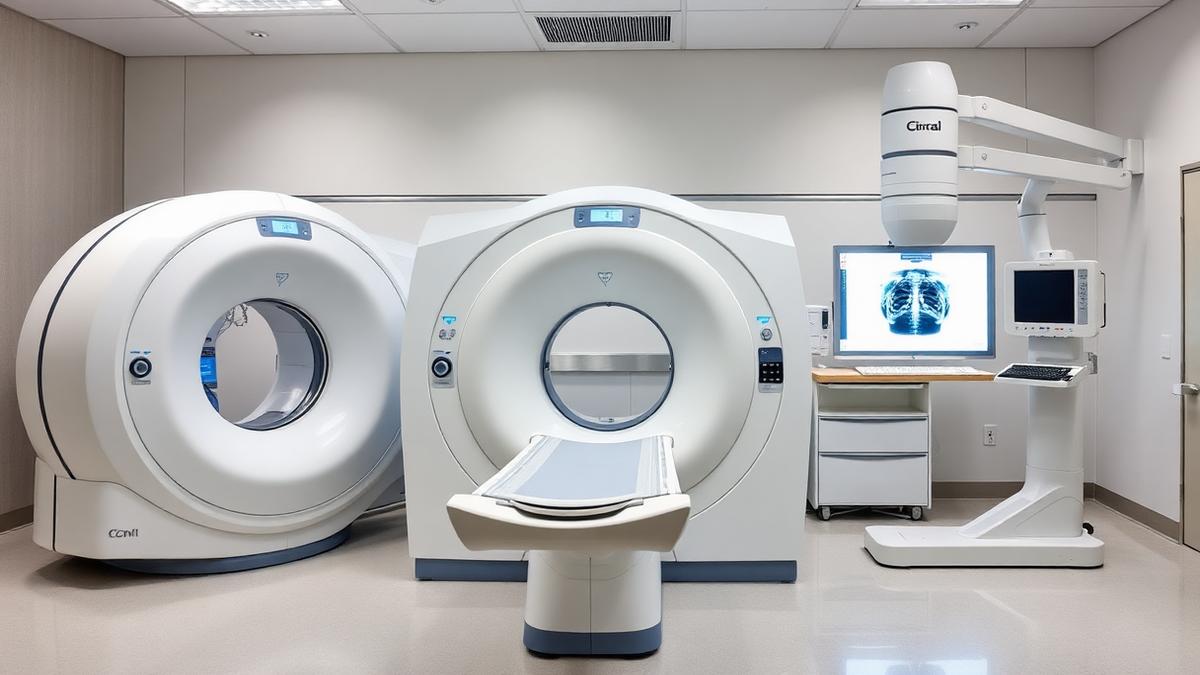
MRI, CT, and digital X-ray equipment side by side in a modern imaging department
    ← Back to Blog|Industry Guide

    MRI vs CT vs DR — Complete Imaging Comparison Guide

    March 12, 202616 min read

    MRI, CT, and Digital Radiography (DR) serve different clinical roles but understanding when to use each modality — and how to prioritize equipment investment — is essential for hospital planning. This guide compares all three across cost, clinical applications, image quality, and developing market considerations.

    Understanding the Three Core Imaging Modalities

    Medical imaging departments typically center on three core modalities: MRI (Magnetic Resonance Imaging) — uses magnetic fields and radio waves to create detailed images of soft tissues, organs, and joints. No ionizing radiation. Best for: neuroimaging, musculoskeletal, cardiac, and oncologic imaging. CT (Computed Tomography) — uses rotating X-ray beams to create cross-sectional images. Fast acquisition, excellent bone and vessel visualization. Best for: emergency imaging, oncology, cardiac, pulmonary, and trauma. DR (Digital Radiography) — digital X-ray imaging for projection radiographs. Fastest and most accessible modality. Best for: chest imaging, bone fractures, dental, and screening applications.

    Each modality has distinct strengths, limitations, and cost profiles. For hospitals in developing markets, understanding these differences is critical for equipment investment decisions — especially when budget constraints mean choosing one or two modalities rather than all three. This comparison guide provides the framework for informed decision-making.

    Cost Comparison: Equipment, Installation, and Service

    Equipment Cost (New/Refurbished): MRI 1.5T — $1.5M–$3M new, $200K–$500K refurbished. CT 64-slice — $500K–$1.2M new, $150K–$400K refurbished. DR System — $60K–$150K new, $20K–$60K refurbished.

    Installation Cost: MRI — $150K–$300K (RF shielding, structural reinforcement, specialized HVAC). CT — $50K–$150K (radiation shielding, power supply, cooling). DR — $10K–$30K (minimal room preparation, standard electrical).

    Annual Service Cost (Third-party/Elesonic): MRI — $90K–$200K/year. CT — $40K–$140K/year. DR — $5K–$30K/year. The cost gap between modalities is dramatic — a DR system's total 5-year cost (acquisition + installation + service) is roughly equivalent to one year of MRI service alone. This makes DR the most accessible modality for developing market hospitals.

    Clinical Application Comparison

    MRI Excels At: Brain and spinal cord imaging (stroke, tumors, MS), joint and musculoskeletal imaging (ligaments, cartilage, tendons), cardiac imaging (function, perfusion, viability), abdominal organ characterization (liver, kidney, pancreas), and breast imaging (MRI mammography). MRI provides unmatched soft tissue contrast without radiation.

    CT Excels At: Emergency imaging (trauma, stroke — fast acquisition), pulmonary imaging (PE, pneumonia, COVID), oncologic staging and monitoring, vascular imaging (CT angiography), bone detail and fracture characterization, and abdominal emergency (appendicitis, obstruction). CT provides the fastest comprehensive imaging and is the workhorse of emergency departments.

    DR Excels At: Chest imaging (pneumonia, TB, heart size), bone fracture detection, skeletal surveys, foreign body detection, orthopedic alignment assessment, and dental/maxillofacial imaging. DR provides the fastest, most accessible, and lowest-cost diagnostic imaging — essential as a first-line tool in any hospital.

    Radiation Dose Considerations

    MRI — zero ionizing radiation. Uses magnetic fields and radiofrequency energy. Safe for repeated imaging including pregnancy (with precautions). The primary safety concerns are related to implanted devices (pacemakers, metal implants) and contrast agent (gadolinium) reactions.

    CT — moderate to high radiation dose. Chest CT: 5–7 mSv, Abdomen CT: 8–15 mSv, Head CT: 2–4 mSv. Modern dose reduction techniques (iterative reconstruction, automatic exposure control) reduce doses by 30–50%. Still, radiation exposure limits the frequency of CT scanning, particularly for pediatric patients and cancer screening.

    DR — low radiation dose. Chest X-ray: 0.02 mSv, Extremity X-ray: 0.001–0.01 mSv, Abdomen X-ray: 0.7 mSv. DR provides diagnostic information at a fraction of CT dose. According to the International Commission on Radiological Protection (ICRP), DR is appropriate as a first-line imaging tool before escalating to CT when more detailed imaging is needed.

    Which Modality Should You Prioritize?

    For hospitals building imaging capability from scratch (common in developing markets), this priority framework applies: Priority 1 — DR/X-ray: Every hospital needs basic radiographic capability. DR provides the highest volume of diagnostic studies at the lowest cost. Start here. Priority 2 — CT Scanner: CT dramatically expands diagnostic capability, enabling emergency imaging, oncology, and cross-sectional anatomy. A 64-slice CT covers virtually all diagnostic needs.

    Priority 3 — MRI: MRI adds unique soft tissue imaging capability that CT and DR cannot provide. Essential for neurology, musculoskeletal, and cardiac imaging. However, MRI's high cost (acquisition + installation + service) means it should typically be the third modality added, not the first.

    For developing market hospitals with limited budgets, the optimal sequence is: start with DR (refurbished $20K–$60K), add CT when budget allows (refurbished 64-slice $150K–$400K), then add MRI when the facility's patient volume and clinical needs justify the investment (refurbished 1.5T $200K–$500K). Elesonic provides all three modalities — refurbished equipment, installation, and ongoing service.

    Technology Trends and Future Outlook

    MRI trends: helium-free magnet technology reducing operational costs, AI-powered reconstruction enabling faster scans, low-field MRI (0.55T) systems offering lower-cost alternatives, and compact MRI designs reducing installation requirements. These developments are making MRI more accessible to developing markets.

    CT trends: photon-counting detector technology improving image quality and enabling spectral imaging, AI reconstruction algorithms reducing radiation dose further, and ultra-fast scan times enabling new cardiac and pediatric applications. Dual-source CT systems provide the fastest scanning for challenging patients.

    DR trends: portable wireless DR panels enabling bedside imaging, AI-assisted interpretation for triage and screening, dose optimization through advanced image processing, and cost reductions making DR increasingly affordable. For developing markets, mobile DR units that can serve multiple facilities represent an innovative access model. Elesonic stays at the forefront of these technology trends, incorporating advances into both new and refurbished equipment offerings.

    Frequently Asked Questions

    What is the difference between MRI, CT, and X-ray?

    MRI uses magnetic fields (no radiation) for soft tissue imaging. CT uses rotating X-rays for cross-sectional imaging — fast and detailed. X-ray/DR uses a single X-ray exposure for projection images — fastest and cheapest. Each modality excels at different clinical applications, and most hospitals need at least two of the three.

    Which imaging modality is cheapest?

    DR/X-ray is the most affordable: equipment $20K–$60K refurbished, installation $10K–$30K, service $5K–$30K/year. CT is mid-range: $150K–$400K refurbished, $50K–$150K installation, $40K–$140K/year service. MRI is most expensive: $200K–$500K refurbished, $150K–$300K installation, $90K–$200K/year service.

    When should I use CT instead of X-ray?

    Use CT when X-ray doesn't provide sufficient information: suspected internal injuries (trauma), evaluation of organs (liver, kidney, pancreas), cancer staging, vascular assessment (CT angiography), and complex fracture characterization. X-ray is the first-line tool; CT provides the detailed cross-sectional imaging when needed.

    When should I use MRI instead of CT?

    Use MRI when soft tissue detail is critical: brain and spinal cord disorders, joint and ligament injuries, cardiac function assessment, liver lesion characterization, and situations where radiation exposure should be minimized (pediatric, pregnant, or repeated imaging). MRI provides unmatched soft tissue contrast.

    Which imaging equipment should a hospital buy first?

    For developing market hospitals: Priority 1 — DR/X-ray (essential, lowest cost). Priority 2 — CT Scanner (dramatically expands diagnostic capability). Priority 3 — MRI (adds unique soft tissue imaging). This sequence maximizes clinical impact per dollar invested. All three are available refurbished from Elesonic at 50–75% savings.

    How much radiation does each modality use?

    MRI — zero radiation (uses magnetic fields). DR/X-ray — very low (chest X-ray: 0.02 mSv). CT — moderate to high (chest CT: 5–7 mSv, abdomen CT: 8–15 mSv). Modern dose reduction techniques reduce CT exposure by 30–50%. DR is safe for frequent use; CT requires clinical justification due to cumulative dose.

    Can CT replace MRI?

    CT cannot fully replace MRI. While CT is excellent for bone, vascular, and emergency imaging, MRI provides superior soft tissue contrast for brain, spinal cord, joints, and cardiac imaging. Many clinical scenarios require both modalities. However, a CT scanner alone provides broader diagnostic coverage than MRI alone.

    What is Digital Radiography (DR)?

    Digital Radiography (DR) uses digital flat-panel detectors instead of traditional X-ray film to capture X-ray images. Advantages: instant image viewing (no film processing), lower radiation dose, digital storage and PACS integration, image enhancement capabilities, and reduced repeat rates. DR is the modern standard replacing analog X-ray and computed radiography (CR).

    How does image quality compare between MRI, CT, and DR?

    Each excels differently: MRI — best soft tissue contrast, excellent spatial resolution for brain/joints, multiplanar capability. CT — excellent spatial resolution, good soft tissue contrast with contrast agents, fast acquisition, 3D reconstruction. DR — good spatial resolution for bones and chest, limited soft tissue differentiation, 2D only.

    What staff training is needed for each modality?

    DR/X-ray — radiographer training (2–3 year diploma minimum). CT — additional CT-specific training (6–12 month certification). MRI — specialized MRI training (6–12 months, safety-critical due to magnetic field). All modalities require ongoing CPD. The training investment increases with modality complexity: DR < CT < MRI.

    Can one technologist operate all three modalities?

    In many developing markets, cross-trained radiographers operate multiple modalities. Basic qualification covers X-ray/DR. Additional training enables CT operation. MRI requires specific safety training due to the magnetic field. Cross-training is common and practical for smaller facilities. Elesonic includes modality-specific application training with all equipment installations.

    How much space does each modality need?

    DR — smallest footprint: 15–20 sqm scan room + 5–10 sqm control area. CT — moderate: 20–25 sqm scan room + 10–15 sqm control room + 8–12 sqm equipment room. MRI — largest: 25–40 sqm scan room (with RF shielding) + 10–15 sqm control room + 10–15 sqm equipment room. Planning space requirements is critical during facility design.

    What maintenance is most expensive for each modality?

    MRI — cryogenic system and helium management ($15K–$80K per incident). CT — X-ray tube replacement ($60K–$150K). DR — flat-panel detector replacement ($20K–$60K). Preventive maintenance from providers like Elesonic minimizes these costs by catching problems early and extending component life.

    Which modality generates the most revenue?

    Revenue per scan varies: MRI — $300–$1,500 per scan. CT — $150–$800 per scan. DR — $30–$150 per scan. However, DR typically generates the highest total volume. Revenue model depends on patient mix, pricing, and volume. For developing markets, CT often provides the best revenue-to-cost ratio due to broad clinical applications.

    Can Elesonic supply all three imaging modalities?

    Yes. Elesonic supplies refurbished MRI, CT, and DR/X-ray systems from all major manufacturers. They also manufacture new X-ray and DR systems (Elemac brand) and C-arm equipment. All equipment comes with installation, training, warranty, and ongoing service support — making Elesonic a single-source provider for complete imaging department setup.

    How do AI advances affect MRI, CT, and DR?

    AI is transforming all three modalities: MRI — AI reconstruction enables 50%+ faster scans with maintained or improved image quality. CT — AI reconstruction reduces radiation dose by 30–50%. DR — AI assists with triage (detecting pneumothorax, fractures) and quality control. AI is making all modalities more efficient and accessible.

    What is the environmental impact of each modality?

    MRI — highest energy consumption (cooling systems run 24/7), helium usage (depleting natural resource). CT — moderate energy consumption, no consumable gases. DR — lowest energy consumption and environmental impact. Refurbishing equipment (extending life by 8–15 years) significantly reduces the environmental footprint of all modalities.

    Which imaging modality is best for emergency departments?

    DR is essential for every ED (chest X-ray, fracture imaging — fastest results). CT is the primary advanced modality for emergency imaging: trauma assessment, stroke evaluation (with CTA), pulmonary embolism detection, and acute abdomen evaluation. MRI is rarely used emergently due to long scan times, though it's valuable for acute stroke (diffusion MRI).

    What contrast agents are used for each modality?

    MRI — gadolinium-based contrast agents (GBCA) for enhanced tissue visualization. CT — iodinated contrast agents for vascular and organ enhancement. DR — no contrast agents used (projection imaging only). Contrast agents add cost and require monitoring for adverse reactions. Not all scans require contrast.

    How do developing markets choose between modalities?

    Key considerations: clinical need (what diseases are most prevalent), budget (total cost of ownership not just purchase price), infrastructure (MRI requires RF shielding and stable power), staffing (availability of trained operators), and service (local maintenance support). Elesonic provides consultation to help developing market hospitals make optimal imaging investment decisions.

    Ready to Reduce Your Service Costs?

    Get a customized service proposal for your imaging equipment — MRI, CT, cath lab, X-ray, or C-arm.