
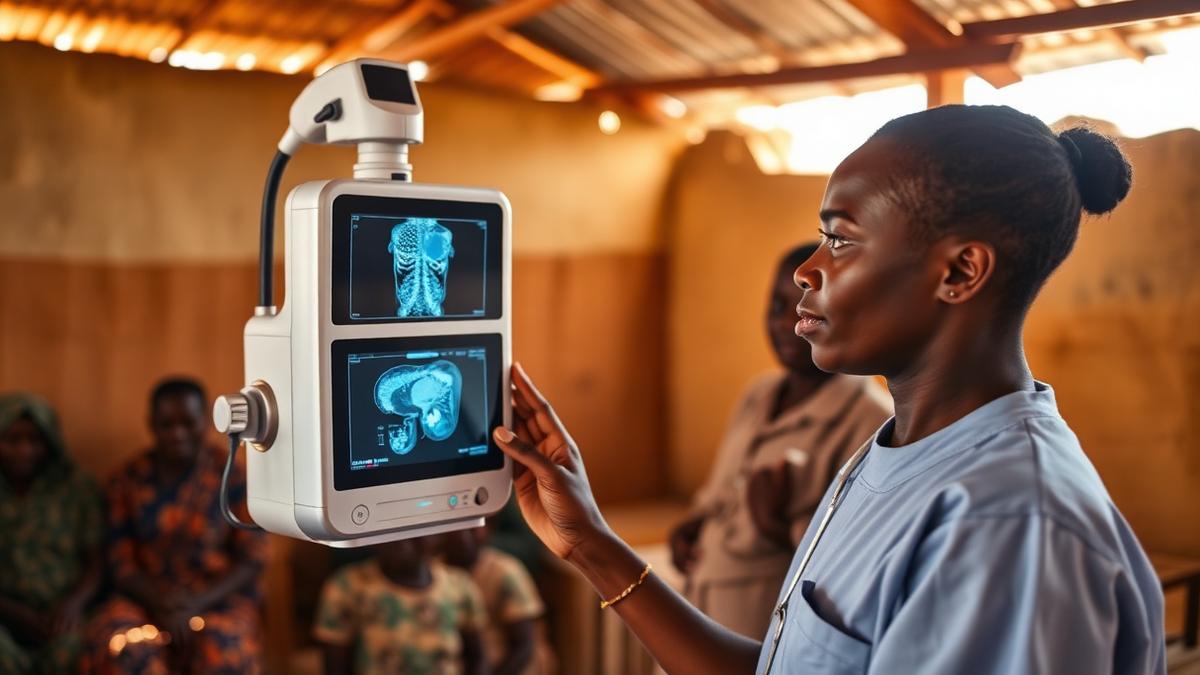
Futuristic medical imaging department with advanced technology and AI interfaces
    ← Back to Blog|Industry Trends

    The Future of Affordable Medical Imaging Technology

    March 11, 202614 min read

    Medical imaging technology is undergoing a revolution that will dramatically improve access in developing markets. From AI-powered diagnostics and low-field MRI to portable CT and equipment-as-a-service models, the future of affordable imaging is closer than ever.

    The Imaging Access Crisis

    The disparity in medical imaging access between developed and developing nations is staggering. According to the WHO and The Lancet Commission on Global Surgery, approximately two-thirds of the world's population lacks access to basic diagnostic imaging. In sub-Saharan Africa, there are roughly 0.2 MRI units per million population compared to over 40 per million in developed nations.

    This imaging gap has direct consequences: delayed diagnoses, unnecessary surgeries (operating without imaging guidance), preventable deaths from undetected conditions, and healthcare systems operating below their potential. The challenge has historically been threefold: equipment cost, maintenance complexity, and trained personnel shortage.

    However, multiple technology and business model innovations are converging to address these barriers. The next decade will see dramatic improvements in imaging accessibility — and forward-thinking providers like Elesonic Group are already implementing many of these innovations.

    AI-Powered Diagnostics: Extending Expertise

    Artificial intelligence is perhaps the most transformative technology for imaging access in developing markets. AI diagnostic tools can: assist interpretation — flagging critical findings like pneumothorax, stroke, or fractures for immediate attention, even when a specialist radiologist isn't immediately available. Automate triage — prioritizing urgent cases in busy imaging departments. Enable remote interpretation — AI pre-analysis combined with teleradiology allows specialist review of images from anywhere in the world.

    For developing markets, AI addresses the radiologist shortage directly. PubMed research shows AI diagnostic tools achieving performance comparable to radiologists for specific tasks: chest X-ray interpretation, mammography screening, CT stroke detection, and fracture identification. While AI doesn't replace radiologists, it extends their reach — enabling one specialist to effectively oversee imaging at multiple facilities.

    Elesonic is integrating AI-assisted capabilities into its service offerings, providing hospitals with tools that enhance diagnostic confidence and efficiency alongside their imaging equipment and maintenance services.

    Low-Field MRI: Breaking the Cost Barrier

    Low-field MRI systems (0.5T–0.55T) represent a paradigm shift in MRI accessibility. Unlike conventional 1.5T and 3.0T systems that require: massive superconducting magnets (liquid helium cooling), RF-shielded rooms (Faraday cages), and specialized high-power electrical supply — low-field MRI can operate with: permanent magnets (no helium, no cryogenics), standard room installation (minimal or no RF shielding), and conventional electrical supply.

    The cost implications are dramatic: Equipment cost — low-field MRI systems cost $200,000–$500,000 (comparable to refurbished 1.5T). Installation cost — dramatically reduced without RF cage and cryogenic requirements. Operating cost — no helium, lower power consumption, simpler maintenance.

    Clinical capability is the trade-off: low-field systems provide lower signal-to-noise ratio, meaning image quality for fine detail is lower than high-field systems. However, they're clinically sufficient for many common indications: brain imaging for stroke and hydrocephalus, musculoskeletal imaging, and basic body imaging. For developing markets where the alternative is no MRI at all, low-field MRI is transformative.

    Portable and Point-of-Care Imaging

    Imaging technology is becoming increasingly portable: portable ultrasound has already revolutionized point-of-care diagnostics. Portable X-ray systems enable imaging at the bedside, in rural clinics, and in disaster response scenarios. Mobile CT scanners (truck-based or trailer-based) can serve multiple facilities on a rotating schedule.

    The next frontier: lightweight, battery-powered DR panels that enable digital X-ray in any location with minimal infrastructure. These devices, combined with cellular connectivity for image transmission, enable imaging in truly remote areas. For countries where patients must travel hundreds of kilometers to reach imaging facilities, point-of-care imaging literally saves lives.

    Elesonic's Elemac range of portable X-ray systems is designed specifically for developing market accessibility — lightweight, robust, and compatible with both grid power and generator/battery operation.

    Cloud PACS and Teleradiology

    Cloud-based Picture Archiving and Communication Systems (PACS) eliminate the need for expensive on-site servers and IT infrastructure. Cloud PACS enables: zero-hardware image storage and management, remote image access from any device, built-in teleradiology workflows, automatic backup and disaster recovery, and pay-per-use pricing models.

    For developing market hospitals, cloud PACS transforms image management from a capital expenditure to an operational expense. Combined with teleradiology, it enables hospitals to outsource image interpretation to specialists anywhere in the world — addressing the radiologist shortage that limits imaging utilization in many developing countries.

    Elesonic supports cloud PACS integration with all imaging equipment installations, ensuring hospitals can leverage these digital infrastructure advances from day one.

    Equipment-as-a-Service: A New Ownership Model

    The traditional model of purchasing imaging equipment (large capital investment + ongoing service costs) is being challenged by Equipment-as-a-Service (EaaS) models. Under EaaS: equipment is provided with no upfront capital cost, a single monthly fee covers equipment, installation, maintenance, and support, technology refresh is built into the contract, and the provider assumes equipment risk.

    EaaS is particularly compelling for developing markets where: capital budgets are limited, maintenance infrastructure is lacking, and technology risk is a concern for facilities new to advanced imaging. The monthly payment model converts unpredictable capital and maintenance expenses into a fixed, manageable operational cost.

    While full EaaS is still emerging in developing markets, Elesonic is exploring these models as part of its mission to make advanced medical imaging accessible to more hospitals worldwide. Elements of this approach — such as combined equipment + service packages with predictable monthly pricing — are already available.

    The Role of Refurbished Equipment in the Future

    Refurbished equipment will remain a cornerstone of imaging access in developing markets for the foreseeable future. Even as new low-cost technologies emerge, refurbished high-field MRI, multi-slice CT, and advanced cath lab systems offer clinical capabilities that purpose-built low-cost alternatives cannot yet match.

    The future of refurbished equipment includes: more sophisticated refurbishment processes incorporating AI-based quality assessment, extended equipment lifecycles through better maintenance technology, integration of modern software features into refurbished hardware platforms, and growing acceptance of refurbished equipment as a legitimate and responsible healthcare investment.

    Elesonic's vertically integrated model — sourcing, refurbishment, sales, installation, and service — positions the company at the center of this evolving market. By combining refurbished equipment expertise with emerging technologies like AI diagnostics and cloud PACS, Elesonic is building the future of accessible medical imaging for developing markets.

    Frequently Asked Questions

    What is the future of medical imaging technology?

    Key trends shaping the future: AI-powered diagnostics extending radiologist expertise, low-field MRI breaking cost barriers, portable imaging enabling point-of-care diagnostics, cloud PACS eliminating infrastructure costs, equipment-as-a-service models reducing capital requirements, and refurbished equipment continuing to democratize access to advanced imaging.

    What is low-field MRI and how does it help developing markets?

    Low-field MRI (0.5T–0.55T) uses permanent magnets instead of superconducting magnets, eliminating helium requirements, RF shielding costs, and specialized power needs. Cost is $200K–$500K with dramatically lower operating expenses. Clinical quality is suitable for many common indications, making MRI accessible to facilities that can't afford conventional 1.5T/3.0T systems.

    How will AI change medical imaging?

    AI will: assist image interpretation (flagging critical findings), automate triage (prioritizing urgent cases), enable remote diagnosis (teleradiology + AI pre-analysis), reduce radiation dose (AI reconstruction algorithms), improve image quality, and extend specialist reach to underserved areas. AI doesn't replace radiologists but dramatically extends their impact.

    What is equipment-as-a-service for medical imaging?

    Equipment-as-a-Service (EaaS) provides imaging equipment, installation, maintenance, and support for a single monthly payment — no large capital investment. Benefits: predictable costs, included maintenance, technology refresh options, and reduced risk. Particularly compelling for developing market hospitals with limited capital budgets.

    Will refurbished imaging equipment remain relevant?

    Yes. Refurbished equipment will remain a cornerstone of imaging access. High-field MRI, multi-slice CT, and advanced cath labs in refurbished form offer clinical capabilities that low-cost alternatives cannot yet match. The refurbishment industry is evolving with better quality processes, extended lifecycles, and integration of modern software features.

    What is cloud PACS and why does it matter?

    Cloud PACS is a cloud-based system for storing, viewing, and sharing medical images — replacing expensive on-site servers. Benefits: zero hardware cost, remote access from any device, built-in teleradiology, automatic backup, and pay-per-use pricing. It transforms image management from capital expense to operational expense, ideal for developing markets.

    How can portable imaging improve healthcare access?

    Portable imaging (mobile X-ray, lightweight DR panels, mobile CT units) brings diagnostics to patients rather than requiring patients to travel to imaging facilities. Combined with cellular connectivity for image transmission and teleradiology for interpretation, portable imaging can serve rural and remote populations where fixed imaging facilities don't exist.

    What role does teleradiology play in developing markets?

    Teleradiology allows specialist radiologists to interpret images remotely, addressing the severe radiologist shortage in developing nations. Combined with AI pre-analysis and cloud PACS, teleradiology enables high-quality image interpretation regardless of the hospital's location. This is particularly valuable for rural facilities and smaller hospitals.

    How is Elesonic preparing for the future of medical imaging?

    Elesonic is: integrating AI-assisted diagnostic tools into service offerings, exploring equipment-as-a-service models for developing markets, supporting cloud PACS integration with all installations, developing portable X-ray/DR solutions for underserved areas, advancing refurbishment technology for extended equipment lifecycles, and building partnerships for teleradiology services.

    What imaging technology advances will benefit Africa most?

    For Africa: (1) Portable DR enabling imaging in rural clinics, (2) Low-field MRI reducing installation complexity, (3) AI diagnostics addressing radiologist shortage, (4) Solar-powered imaging systems for off-grid locations, (5) Cloud PACS eliminating IT infrastructure requirements, and (6) Equipment-as-a-service reducing capital barriers. Elesonic is actively implementing several of these innovations.

    Will 3D printing impact medical imaging?

    3D printing impacts imaging indirectly: creating patient-specific anatomical models from imaging data for surgical planning, manufacturing custom parts for equipment maintenance (reducing dependence on OEM parts supply), and potentially producing imaging accessories and phantoms locally. These applications are emerging but not yet widespread in developing markets.

    How does 5G connectivity affect medical imaging?

    5G enables: faster transfer of large imaging files (especially MRI and CT datasets), real-time remote support and diagnostics, mobile imaging units with cellular connectivity, AI cloud processing of imaging data, and virtual reality consultation using 3D imaging datasets. As 5G expands in developing markets, these capabilities become increasingly practical.

    What is spectral CT and when will it be widely available?

    Spectral CT uses photon-counting detectors to differentiate materials based on X-ray energy — enabling: virtual non-contrast imaging, material decomposition (e.g., separating calcification from contrast), improved tissue characterization, and potential radiation dose reduction. Currently limited to premium new systems. Refurbished spectral CT will become available as current systems age into the refurbishment pipeline.

    How can developing market hospitals prepare for imaging technology changes?

    Preparation strategies: (1) Build modular facilities that can accommodate future equipment, (2) Invest in network infrastructure for cloud PACS and teleradiology, (3) Train staff in digital workflows and AI tools, (4) Partner with future-focused providers like Elesonic, (5) Consider scalable contracts that allow technology upgrades, and (6) Stay informed about emerging low-cost imaging solutions.

    What is the Elesonic Elemac product line?

    Elemac is Elesonic's own manufactured range of imaging equipment designed for developing markets: Elemac X-ray systems (fixed and mobile), Elemac DR panels (digital radiography detectors), and Elemac CFD-9 C-arm (mobile fluoroscopy). All products are CE certified, competitively priced, and supported by Elesonic's manufacturer-direct service infrastructure.

    How much does medical imaging cost per scan?

    Cost per scan (approximate): DR/X-ray — $5–$30 operational cost, charged at $30–$150. CT — $20–$80 operational cost, charged at $150–$800. MRI — $50–$200 operational cost, charged at $300–$1,500. Revenue margins depend on equipment acquisition cost, service model, and local pricing. Refurbished equipment with third-party service maximizes margin per scan.

    What is the WHO recommendation for imaging access?

    The WHO recommends: minimum 1 X-ray unit per 50,000 population, access to CT and ultrasound at district hospital level, MRI availability at regional/national hospital level, trained radiographers at every imaging-capable facility, and maintenance programs to ensure equipment functionality. Current developing market realities fall far short of these recommendations.

    How does medical imaging technology help global health?

    Medical imaging enables: accurate diagnosis (reducing misdiagnosis and unnecessary treatments), surgical planning (improving outcomes), disease monitoring (tracking treatment response), screening programs (early detection), and public health surveillance (monitoring disease patterns). The WHO considers diagnostic imaging essential to achieving Universal Health Coverage (UHC).

    What sustainability practices exist in medical imaging?

    Sustainability in imaging: equipment refurbishment extends lifespan by 8–15 years (reducing waste), energy-efficient designs reduce power consumption, helium recycling reduces rare gas depletion, cloud computing reduces on-site IT infrastructure, and mobile imaging reduces facility construction needs. Elesonic's refurbishment model is inherently sustainable — maximizing value from existing equipment.

    How can I stay updated on medical imaging technology trends?

    Follow: RSNA (Radiological Society of North America) conferences and publications, ECR (European Congress of Radiology), WHO health technology publications, PubMed medical imaging research, and industry providers like Elesonic who publish educational content. Subscribe to Elesonic's blog for developing market-focused imaging technology insights.

    Ready to Reduce Your Service Costs?

    Get a customized service proposal for your imaging equipment — MRI, CT, cath lab, X-ray, or C-arm.