
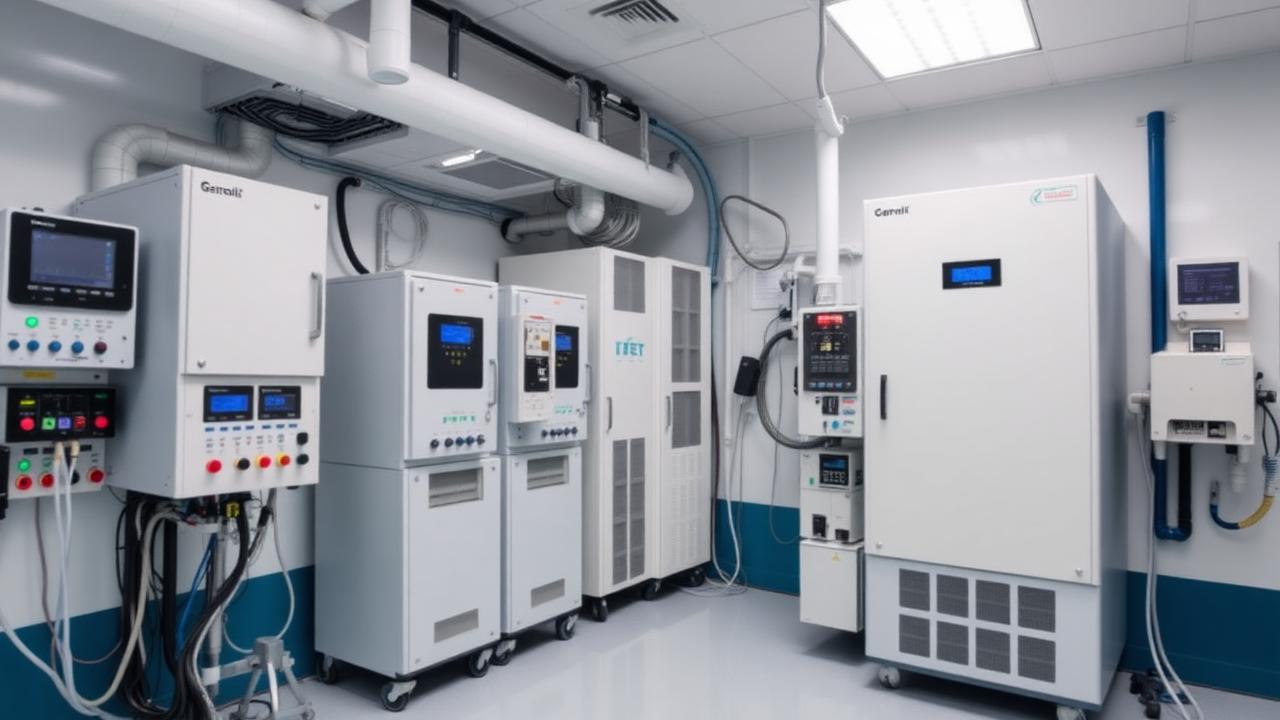
Poor power quality is the #1 environmental cause of imaging equipment failure in developing markets. This guide covers everything facilities need to know — from voltage regulation and grounding to UPS sizing and harmonic mitigation.
Why Power Quality Is Critical for Imaging Equipment
Medical imaging systems are among the most power-sensitive devices in a hospital. A CT scanner draws 80–120 kVA during a scan, an MRI system requires a dedicated 100–200 kVA supply, and a cath lab can peak at 150 kVA during angiography.
Voltage sags as brief as 100 milliseconds can corrupt a CT scan, trigger MRI quench protection, or damage cath lab flat-panel detectors. In regions with unstable grid power — common across West Africa, the Caribbean, and parts of India — power quality issues account for up to 40% of all imaging service calls.
Elesonic Group's site survey process always begins with a comprehensive power quality audit before any equipment installation.
Voltage Regulation Requirements
Most imaging OEMs require supply voltage within ±10% of nominal. For critical systems (MRI, cath lab), tighter regulation of ±5% is recommended.
Automatic Voltage Regulators (AVRs) or servo-stabilizers should be installed on the dedicated imaging circuit. Key specs: regulation accuracy ≤ ±1%, response time < 20 ms, and capacity rated at 125% of the system's peak draw.
Three-phase balance is essential — phase-to-phase voltage imbalance must not exceed 2%. Imbalanced phases cause motor overheating in CT gantry drives and gradient amplifier failures in MRI.
Grounding and Bonding
A dedicated technical ground with impedance < 5 ohms is mandatory. This must be separate from the building's lightning protection ground and bonded at a single point.
The imaging room should have an equipotential grounding grid — all metal surfaces (conduit, table frame, gantry, shielding) connected to a common ground bus bar.
Ground impedance must be tested annually with a fall-of-potential method. In tropical climates with high soil resistivity, chemical grounding rods or ground enhancement compounds may be needed to achieve < 5 ohms.
UPS Sizing and Configuration
Online double-conversion UPS is the standard for imaging equipment. It provides continuous voltage regulation and seamless transfer during power outages.
Sizing rule: UPS capacity = peak system draw × 1.25 (derating factor). For a 100 kVA CT scanner, specify a 125 kVA UPS minimum. Battery runtime of 10–15 minutes is sufficient for controlled shutdown; longer runtime requires generator backup.
Critical: the UPS must have an input isolation transformer and output THD < 5% at full load. Some MRI installations also require the UPS to handle the high inrush current of the cryocooler compressor (up to 6× running current for 200 ms).
Harmonic Mitigation
Imaging equipment with high-frequency inverters and switching power supplies generates harmonic currents (primarily 3rd, 5th, and 7th). Total Harmonic Distortion (THD) on the voltage waveform should be kept below 5% per IEEE 519.
Solutions include active harmonic filters, K-rated transformers (K-13 minimum for imaging loads), and oversized neutral conductors (200% of phase conductor size) to handle triplen harmonics.
Elesonic Group includes harmonic analysis as part of our pre-installation power survey. We work with local electrical contractors to specify and verify mitigation measures before commissioning.
Surge Protection
A tiered surge protection strategy is essential: Type 1 (service entrance), Type 2 (distribution panel), and Type 3 (point-of-use at the imaging system's disconnect switch).
In lightning-prone regions (tropical Africa, Caribbean), supplemental surge arrestors with < 1 ns response time and > 100 kA surge capacity are recommended on the imaging circuit.
Data lines (Ethernet, DICOM connections) must also be surge-protected. A single lightning-induced surge on an unprotected network cable can destroy the imaging system's host computer.